
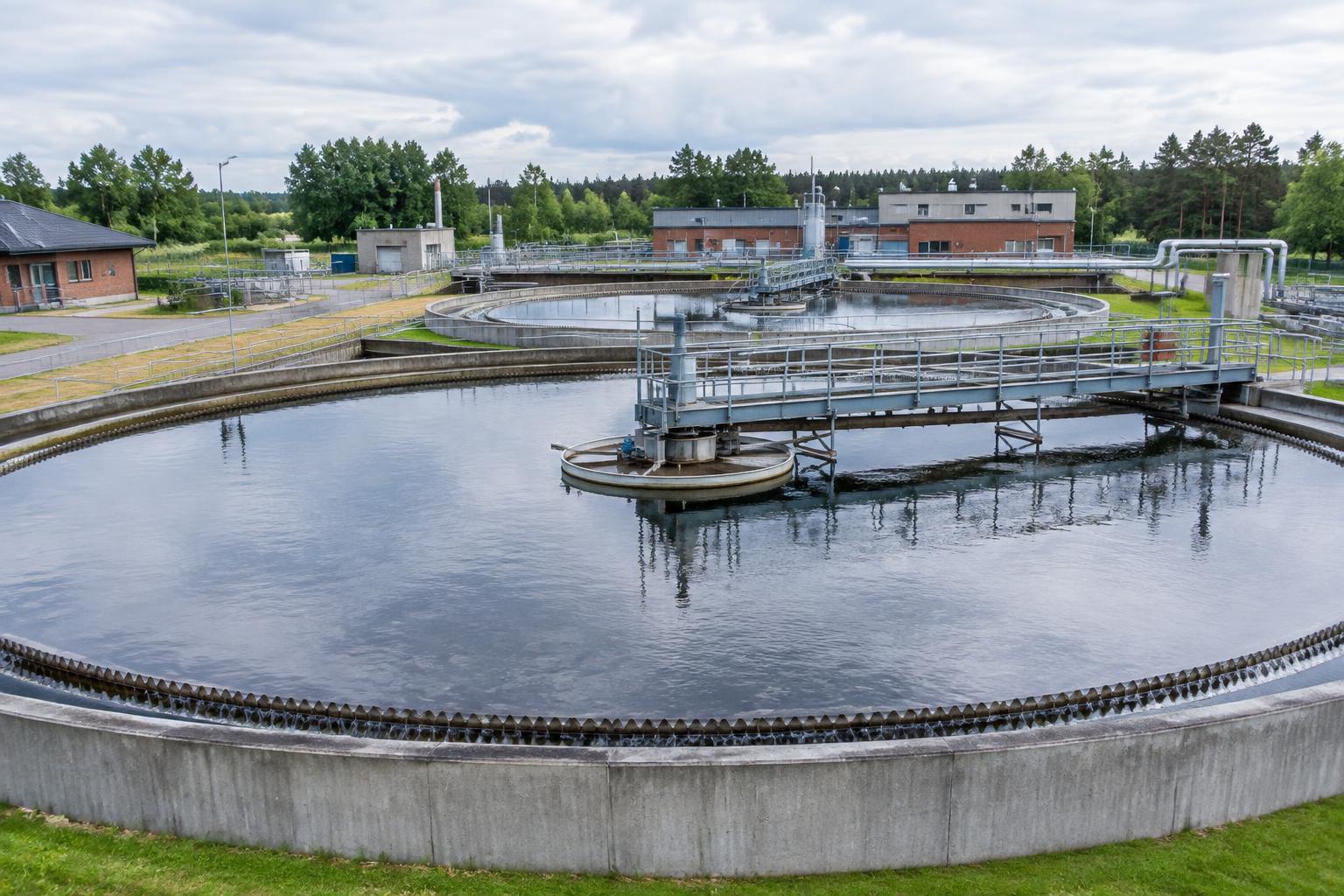
Illustrative municipal wastewater treatment plant with circular settling basins and walkways

BioCell Analytica · Wastewater Treatment

Measure what your wastewater treatment really achieves.

Understand how effectively treatment processes reduce biological activity — and what remains in the treated water.

Wastewater contains complex mixtures of pharmaceuticals, household chemicals and other contaminants. Conventional chemical analysis identifies selected substances, while effect-based methods provide complementary information about the biological activity of these mixtures.

BioCell Analytica helps wastewater utilities assess treatment performance, investigate residual biological effects and strengthen their monitoring programmes.

Understanding what remains after treatment

Beyond chemical removal. Understanding biological effects.

Conventional wastewater treatment reduces many contaminants, but biological activity may remain in treated effluent. Effect-based methods measure combined mixture activity across different toxicological endpoints. Highly sensitive effect-based methods can detect residual estrogenic activity even when individual estrogens are below the detection limits of conventional chemical analysis.

By analysing wastewater before and after treatment, we can evaluate changes in biological activity — and identify effects that remain in the final effluent.

  1. Influent

    Untreated wastewater

    What biological activity enters the treatment plant?

  2. Treatment performance

    Treatment

    How much is the measured biological activity reduced?

  3. Effluent

    Treated effluent

    What biological activity remains after treatment?

Three ways to strengthen wastewater monitoring

Better information for better treatment decisions.

01

Measure treatment efficiency

How effectively does your treatment process reduce biological activity?

By comparing influent and effluent, we can quantify the reduction of measured biological effects across different toxicological endpoints. This provides complementary information about overall treatment performance.

02

Understand residual biological effects

What remains in the treated wastewater?

Our analyses help identify residual effects, including hormonal activity, cellular stress responses and genotoxicity. Results can be interpreted using relevant effect-based trigger values or historical reference measurements where appropriate.

03

Monitor changes over time

Is treatment performance consistent?

Repeated effect-based measurements help identify changes in biological activity over time — supporting long-term monitoring, investigations of unexpected changes and assessment of treatment performance.

From monitoring to meaningful insights

Understanding your results in context.

Measuring biological activity is only the first step. Understanding its significance makes the results more useful. BioCell Analytica combines scientific expertise with experience from more than 6,000 effect-based measurements.

Depending on the endpoint and water type, analytical results can be compared with relevant historical data or scientifically derived effect-based trigger values.

  • Identify unusually elevated biological activity.
  • Understand differences between influent and effluent.
  • Evaluate changes in treatment performance.
  • Prioritise monitoring and further investigations.

Our goal is to turn complex analytical data into useful information for wastewater management.

See how analytical results support treatment decisions

6,000+

effect-based measurements

Extensive analytical experience and scientific interpretation.

Responding to new wastewater treatment requirements

Preparing for a new generation of wastewater treatment.

European wastewater legislation is increasing the focus on micropollutants and advanced wastewater treatment. The revised Urban Wastewater Treatment Directive (EU) 2024/3019 introduces phased requirements for quaternary treatment to remove micropollutants at relevant wastewater treatment plants.

As utilities plan treatment upgrades and evaluate performance, effect-based methods provide valuable complementary information about changes in biological activity.

Better information supports better treatment decisions.

Revised EU Urban Wastewater Treatment Directive

Real-world evidence

Insights from six Swedish wastewater treatment plants.

Effect-based analysis provides valuable information about treatment efficiency and biological effects that conventional chemical analysis alone may overlook.

6

wastewater treatment plants

In a Sweco-led innovation project, effect-based methods were used to evaluate wastewater treatment performance at six Swedish plants. BioCell Analytica performed the biological analyses, covering hormonal activity, oxidative stress, Ah-receptor activation and genotoxicity. The study investigated conventional treatment, advanced treatment technologies and receiving waters.

01

Biological effects can remain after conventional treatment

Conventional treatment substantially reduced several measured biological activities, yet estrogenic activity remained elevated in some treated effluents. Genotoxic activity was also detected in treated effluent at most of the investigated plants.

Measuring what remains is as important as measuring what is removed.

02

Advanced treatment can provide additional reductions

Pilot investigations demonstrated substantial additional reductions using ozonation and granular activated carbon. Estrogenic activity reductions exceeded 98.0% in the investigated advanced ozonation process, with similarly strong performance for granular activated carbon under the studied conditions.

Effect-based analysis helps demonstrate the added value of advanced treatment.

03

Chemical analysis does not always explain the measured biological effects

In this Swedish wastewater investigation, targeted chemical analysis accounted for no more than 3% of the estrogenic activity detected by effect-based methods. This finding applies to the investigated wastewater samples and chemicals analysed.

Effect-based analysis reveals information that targeted chemical analysis may miss.

“It can be said that it was a good decision to use the methods because we were able to draw conclusions that were previously not possible.”

Gisela Holm

Ecotoxicologist and Water Specialist, Sweco

Read the original customer story

Read the full report

Effect-based analyses for evaluating treatment efficiency and environmental risks in wastewater

Lessons from six wastewater treatment plants using conventional and advanced treatment.

Sweco, 2022 · Gisela Holm and Linda Önnby

Read the Sweco report (PDF, Swedish)
Explore treatment technology applications

Quality & analytical expertise

Scientific expertise. Quality-assured analysis.

BioCell Analytica combines advanced cell-based analytical methods with established laboratory procedures and scientific interpretation. Our laboratory is accredited by Swedac according to ISO/IEC 17025 for specified analyses of genotoxicity and acute fish-cell toxicity in relevant water matrices. Other analytical methods are performed under established internal quality requirements.

Get more insight from your wastewater.

Discover how effect-based analysis can strengthen your monitoring programme and treatment evaluation.

Whether you want to assess treatment performance, investigate residual biological activity or establish a long-term monitoring programme, our scientists can help you select a suitable analytical approach.